For those that have read Openings, here’s a recent article on one of the restaurants featured – Whistlin’ Jack’s.
Coming to you soon – Flitters
For those who have read my first book, Surveyor, you might recall the Flitter – a vehicle that flies like a drone. Well, it’s now a reality – introducing the Jetson ONE.
Incommunicado
Over the weekend, an Icon passed. You may have heard of him – Jimmy Buffett.
While I never met the man, he had quite the influence on my life. I still remember when “Come Monday” was first released (yes, I’m that old). Every time it would come on the radio, I would stop whatever I was doing, sit down, and listen to it.
Years later, I went to my first Jimmy Buffett concert in Miami. It was a blast! At that moment, I became a Parrot Head. Arms up, hands together like I was praying, arms swaying side to side to the beat of “Fins”.
The quote in my Master’s thesis (which my advisors wanted me to remove, which I adamantly refused to do) is “I ate the last mango in Paris, took the last plane out of Saigon. I caught the first fast boat to China, but Jimmy, there’s still so much to be done.” I love that quote. There’s still so much to be done. I live my life that way (or try to). You should, too.
I met my wife at a wedding, but our relationship was completely platonic for years. One fall, I had tickets to see Jimmy at the Shoreline Amphitheater, but my date blew me off. I called my now wife and said, “Wanna see Jimmy Buffett?” Eight months later we were engaged.
Our first dog (pre-engagement) was a big, goofy Yellow Lab we named “Joe Merchant” after Jimmy’s novel, Where is Joe Merchant?
When we got married, our first dance was a Jimmy Buffett number from his newest release. Sadly, I don’t remember which one (but it was likely “Blue Heaven Rendezvous).
My first professional presentation was at the Association of American Geographers annual conference in Honolulu in 1999. The title of my presentation? “Where is Margaritaville? The physical manifestation of place perception.” It was all about how people took Jimmy’s song and transformed them into restaurants that fit their version of Margaritaville. In a sad sort of way, many of them had to shut down as Jimmy pushed legal action to make Margaritaville his own brand. I understand, but I think it deprived us Parrot Heads of the many interpretations I had uncovered. Maybe I’ll post an image or two (if I can find the slides – yes, we’re talking actual film slides, pre-PowerPoint, where one used a slide projector).
As many of you know, I walked the Camino de Santiago a couple of times. After the first Camino (a short one), my wife and I drove to Marseilles, just so I could stand at the waters edge, along the coast, and listen to Jimmy sing “Coast of Marseilles.” Yeah, weird, but that’s what I like to do. We then went to Paris, where I had a dish with a mango. My photo caption on my private Facebook page says
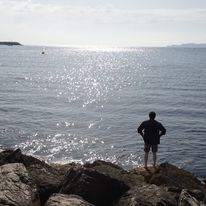
Coast of Marseilles (if you look real close, you might see my iPod earbuds). From my FB Page: “Nothing says Bucket List quite as good as listening to Jimmy Buffett’s “Coast of Marseilles” while standing on the Coast of Marseilles in Marseilles, France.”
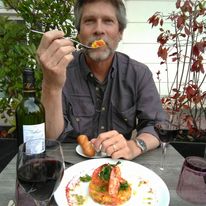
Last Mango in Paris. From my FB Page: “Eating the last mango in Paris.”
A lot of us Parrot Heads are using the same line to sum up how we feel about Jimmy’s passing: Some of it’s tragic, and some of it’s magic, but he had a good life all the way.”
RIP Jimmy Buffett – fair winds and following seas. You’ve gone incommunicado, but your legacy lives on.
TIPS for the TAT – Part I
Since this never got published in ADV magazine (despite the editor saying it was a go, then the new editor wanted a dumbed down 10 point article), I figured I post this article here. It’s in three parts, so they’ll be coming out separately.
This article is basically some of the things I learned riding the Trans-America Trail last summer. Enjoy.
TIPS for the TAT – Part I (what one novice learned while tackling the Trans-America Trail)
In the summer of 2022, I decided to do the Trans-America Trail, a route crossing the United States on mostly unpaved roads and trails. I had extensive road bike experience, but this would be my first time venturing out into the world of Adventure biking. As with most, I did extensive research and watched many a YouTube video. I also took a dirt bike safety training course and participated in a couple of rides in Washington’s Cascade Mountains. I thought I was prepared. For the most part, I was, but there’s always room for improvement. Along the way, I learned from other TAT riders and from myself and my motorcycle, a 2022 Royal Enfield Himalayan. Here are my tips for the TAT.
Prepare Yourself
Before venturing out on your bike, invest some time, energy, and money in yourself. If most of your prior riding experience is on-road, as was mine, then take an off-road riding course. I can’t stress this enough. Off-road riding, which includes riding gravel and dirt roads and single-track/4×4 trails, is something most ADV riders will eventually wind up doing. And, it’s completely different than riding on pavement. I was extremely grateful for the knowledge I obtained from the training I took.
After completing the training, go on trail rides. Start with others at the beginner level and then work up to intermediate. Nothing beyond that is really necessary for the TAT, but any time spent improving on what you learned is time well spent.
Another good skill to develop is your tumbling skills. Let’s face it, you’re going to drop your bike on the TAT. That’s pretty much a given. Even the best of riders do, usually in the mud. Pretty much every time I dumped my bike was while traversing mud. While most dumps were at really low speeds (less than 2 mph), one dump was while I was in third gear going about 25 mph or so. Fortunately, when the bike went down, I did a good tuck-and-roll and sustained no injuries. The same couldn’t be said for the low-speed dumps, where my ankle got twisted once and I got pinned twice.
Get physically fit. You’re going to spend about three weeks on dirt/gravel roads and trails. This means lots of time on your pegs. For that, you’re going to want to develop your quads. Do squats or leg presses. You’ll also be lifting your bike, so make sure your upper body and back are also prepared. Bench presses, overhead presses, curls, and any exercises to help your lower back will prove beneficial.
Learn to lift your bike safely. Don’t just bend over and pick it up by the handlebars – do whatever is necessary to ensure you don’t tweak your back. When picking up your bike by yourself, you can either elect to walk it up or squat-pick it up. Walking it up entails facing the bike, getting your upper body under it, and while keeping your back straight, walking forward with your knees, pushing the bike to the upright position. To squat-pick up your bike, squat down the seat side, facing away from the bike, grab two hard-points (handlebars and crash bars or something similar) and stand up, keeping your back straight. Once the bike is upright, put the kick-stand down.
Another way of picking up the bike is the monkey-lift method, where a buddy helps out. The buddy will hold on to the outside of the bike, placing feet on the bottoms of the tires. You can then lift the bike by the handlebar while the buddy serves as a counterweight. Bret Tkacs of Mototrek has a great video on these technique at https://www.youtube.com/watch?v=45iv6pdogLo.
Just remember, you’ll be riding at elevations from sea level to over 11,000 feet – you’ll want to be fit enough to pick up your bike at any elevation. It takes a lot more out of you to pick up a bike at 11,000 feet than at sea level.
Along with going on trail rides, spend some time practicing on the various roadway mediums you’ll be encountering. This will include sand, mud, loose gravel, and water-crossings. If possible, spend time in gravel parking lots doing u-turns. You’ll be spending a lot of time on gravel and being able to safely turn and evade obstacles is a must. You’ll also want to spend some time on rough trails, those with big rocks, loose rocks, and deep ruts. While there aren’t many of these types of roads/trails on the TAT, there are enough that knowing how to safely ride them and pick your way through the various obstacles will prove extremely valuable.
The Bike
Some of you may already have your Adventure Bike, but for those planning on getting one, my recommendations are to get one that is enough, but not too much. Not everyone needs a BMW R1250GS (I know, heresy). People have done the TAT on little Honda 125 Groms. I did it on a 411cc Royal Enfield Himalayan. It was enough for me.
If you’re riding alone, keep in mind you’ll likely be picking up your bike (sometimes several times a day, depending on the mud/rock conditions). You’ll want one you can lift up several times a day in adverse conditions. Perhaps lighter is better in this case.
Of course, you’ll also want one that will carry you and all your equipment. If you’re camping out, that means you’ll need to carry more than if you’re moteling/hoteling it across America. My Himalayan was sufficient to carry me in full gear along with everything I needed for camping out (tent, sleeping bag, sleeping pad, cooking equipment, and food).
You’ll need a bike that can ride both pavement and off-pavement. This usually means an Adventure bike, a dual-sport bike, or a scrambler. Stay away from regular street bikes – they’re not built for the beating that will ensue. It’s not just that you’re riding on dirt or gravel, it’s that there are massive bike-swallowing potholes and washboarding that beats up both you and your bike. I had two Rotopax cans eject themselves from my bike while riding on washboarding, due to all the vibration.
Another consideration when choosing a bike is the ability to get it serviced or repaired along the way. While I love my Himi, I found it difficult to find qualified mechanics, having to go hundreds of miles off the TAT to get it serviced or repaired. I recommend choosing a bike that’s easy to service and get parts for. I’m still looking for a gear shift lever to replace the one I bent when I dumped the Himi at speed.
Bike Modifications
Not many bikes come ADV prepared, so you’ll likely need to make some modifications (or add “farkle” as it’s called).
The primary modification I recommend is installing engine crash guards. Let’s face it, you’re going to dump the bike, likely multiple times. Engine crash guards not only protect the engine, but also give you additional hard points to be able to lift the bike. Other bike protection to consider are a skid plate and a master cylinder guard. These should protect your bike from rocks and sticks, especially when riding in loose rock terrain.
Handguards not only serve to protect your hands, but also protect your brake and clutch levers. A little investment here can likely save you the hassle of trying to ride to the nearest town to replace a broken lever.
Most ADV/dual-sport bikes have a muffler that rises to the rear of the bike. If you’re using soft panniers, you’ll want to install a heat shield over the muffler to prevent your bags from melting (ask me how I know).
If your bike has a second front fender, one that practically rests on the front tire, get rid of it. According to long-time TAT rider Scott Stevenson of Three Steps Hideaway in Utah, mud caking between the fender and the tire can lead to sudden deceleration, which can lead to being ejected over the handlebars. Many a broken femur has resulted in this manner.
While you’ll be doing plenty of pavement riding, I found that dual-sport tires worked best for me. There was a huge-difference in my bike handling in the mud and sand when I switched over from the stock 70/30 tires to dual-sport tires with more aggressive tread.
At times, you’ll be going 200 miles between gas stations. If you can’t make 200 miles, then you might have a slight problem. If you can, put a larger tank on your bike.
As you’ll be spending a lot of time on your pegs, make sure you’ve got a set that are big enough for your feet. You’ll also want to remove any rubber inserts. Rubber inserts, while adding comfort to most riders, can prove lethal when riding through wet environments like water crossings and mud. Your boot is prone to slide off them, which is not a good thing.
Most of you will likely use a smart phone, GPS, or both. If so, you’re going to want to mount them somewhere on or near the handlebars, but also in a place that doesn’t obstruct your instrument panel or other controls. I mounted a Garmin Zumo GPS on a special GPS mount for my Himi. For the phone, I wound up purchasing a RAM mount along the way. I had originally intended to keep my phone in the tank-map case, but found out the enclosed environment generated too much heat for the phone. I don’t recommend the RAM mount, as the rubber supports tend to come off (especially when you dump the bike in mud). I’ll be replacing my RAM mount with a Quad-Lock mount.
Another useful modification is to install a USB charging port. I bought one with an on-off switch, specifically so it wouldn’t accidentally drain my battery if I forgot to unclip it. A voltage display on the top of the unit always let me know if it was on or off.
A tank bag/map case is a great place to store maps and other essential items. I used mine to store maps, business cards, emergency first aid supplies, and a bag of gorp. Make sure whatever bag you choose is big enough to actually use maps and is waterproof – “water resistant” doesn’t cut it.
For carrying gear, you’ve got lots of options – packs, bags, soft panniers, hard panniers, etc. I used both waterproof soft panniers and waterproof bags, a system I highly recommend (but remember, less is more). Why soft panniers? Because you’re less likely to break your leg if the bike falls on you.
If you’re planning on carrying gear that won’t fit in the panniers (such as a chair or a bag across the back), then you’ll want some manner of securing it to the bike. I found the ROK adjustable straps to be the best out there. These straps secure to your bike by looping through themselves, and then to each other with quick-release buckles. One strap is stretchy, and the other is regular webbing with a buckle to adjust the length.
One modification I made, but not totally necessary, is to add a locking trunk (a small case on the back of your bike). I used mine to carry basic tools and emergency equipment. You don’t necessarily have to buy a motorcycle trunk – I bought a hard tool case and drilled holes to mount it to my bike. I wanted something waterproof and that I could lock, but was smaller than the typical motorcycle trunk.
That’s a Wrap This Time
In short, any novice preparing for the TAT should start off prepare his or her self by learning how to safely fall and ride off-road. You should also find a bike that’ll do what you need – carry you and your gear safely off-road, while not being so heavy you can’t pick it up multiple times in a day. Bike modifications might be necessary; don’t break the bank, but be sure you’ve got everything you’ll need.
The Crossing
If you were ever in ROTC, then the latest paperback release by Kevin Ikenberry, The Crossing, should be an interesting read to you. I found it fun and took me back in time a bit. It’s part of Eric Flint’s 1632 series.
Touratech Rally
The Touratech Rally begins in four days – going from Thursday through Sunday in the thriving metropolis of Plain, WA. For those unaware, it’s a gathering of Adventure Motorcyclists (ADV Riders) who come together to learn how to ride off-pavement and on trails, and the tricks involved in traveling long distances on motorcycles with little gear on such roads (watch Ewan McGregor and Charley Borman’s Long Way Round or Long Way Down movies/documentaries to gain a better understanding of what this is like.
As most of you know, I rode my ADV Bike, a 2022 Royal Enfield Himalayan cross country last summer, spending about three weeks on the Trans-America Trail. Quite the ride (with many spills). So this week, I’ll be talking about that at the Rally, giving my Tips for the TAT to those interested in doing the same thing.
If you’re in/near Plain or Leavenworth, WA, let me know. Always glad to hook up with readers/fans for coffee or something similar (sorry – no adult beverages while I’m riding).
Check out the videos on YouTube
So far I’ve produced two long videos (about 12-14 minutes) and two shorts on YouTube. Be sure to check them out, subscribe to the channel, and if you like the videos, click on that silly like button.
If you’re a writer/content creator, do me a favor and share the channel. The goal is to ensure content creators get it right when writing/creating content (this includes novelists, non-fiction writers, script writers, game developers, film directors, and the attendant support staff of editors and audiobook narrators.
Action & Adventure Tips
That’s the title of my new YouTube Channel, which (hopefully), the first video will be visible today.
So, what’s this channel about? Educating content creators! Lot’s of content creators, be they novelists, scriptwriters, film directors, and game developers, along with their support (audiobook narrators, editors, and artists), don’t always know the specifics of some things on what they’re creating content. Case in point, the Glock Safety. Check out the channel, subscribe, and if you’re a content creator, please spread it around. The goal is a tip a week.
Something New
As if I didn’t have enough to do (yeah, I know, you don’t care about new stuff – where’s the next book?), I’ve decided to start a YouTube channel. With any luck, I’ll have things out starting next week. Ran my first test yesterday and today. Definitely have some kinks to work out (hence the tests). I think it’ll be interesting. Stay tuned.
Embracing AI
With all the gnashing of teeth and wailing by writers and artists, I’m going against the flow by embracing Artificial Intelligence. Not in the aspect of actual writing, but for translation purposes.
Using an AI software program, I’m able to translate my works into other languages, thereby reaching more readers in other countries. Is it perfect? No. I have to have people proofing and copy editing to make it so. Is it costing me money? It most certainly is, but far, far less than paying a human to translate things. Think about it – a translation of just one of my books into one language would cost about $12,000 (yes, there are three zeroes after the 2!). I’m doing this for a fraction of the cost. Four books translated into German and one book translated into Spanish has cost about $100 so far. And, I’ll be able to do another 54 books this year on that single payment!
First up, Germany (thanks to having my books be compared to the famous German novelist Karl May). Second up, Spanish, then French, and then, who knows?
Change is coming people – best to either embrace it and adapt or be considered extraneous to the economic system.
BTW, any work derived from my original work is considered derivative works protected under copyright laws.

